

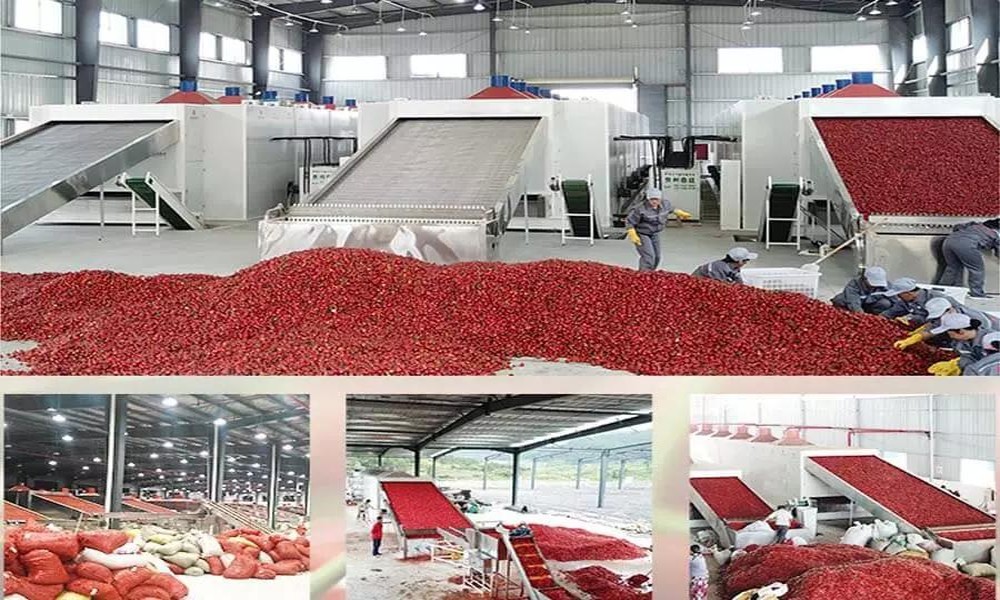
Drying is a critical step in food processing because it removes moisture from raw materials or intermediate products, helping extend shelf life, improve stability, and reduce transportation costs.
Industrial drying machines are widely used to produce dried foods such as milk powder, coffee, spices, fruits, vegetables, and starch products.
Different types of drying equipment are used depending on the physical form of the food, production capacity, and required product quality.
1. Spray Dryers
Spray dryers are one of the most important industrial dryers used in the food industry, particularly for converting liquid or semi-liquid materials into powder. In this method, the liquid feed is transformed into fine droplets and introduced into a chamber filled with hot air. The moisture evaporates almost instantly, leaving fine dry particles that are collected using cyclones or filters.
Spray dryers are widely used for producing dairy powders such as milk powder and whey protein. They are also commonly used for drying coffee extracts, flavorings, enzymes, and food additives. Their main advantages include rapid drying, uniform particle size, and the ability to produce high-quality powders with good solubility.
2. Fluidized Bed Dryers
Fluidized bed dryers are commonly used to dry granular or particulate food products. Within this system, hot air passes upward through a perforated plate, keeping particles suspended and allowing them to behave like a fluid. This movement allows for efficient heat transfer and uniform drying.
These dryers are ideal for drying products such as grains, peas, diced vegetables, and powdered food ingredients. Because of the high heat transfer rate, fluidized bed dryers provide faster drying and better product uniformity compared to many traditional drying methods.
3. Drum Dryers
Drum dryers, also known as roller dryers, are used mainly for drying liquid or semi-liquid food materials. The process involves spreading a thin layer of product onto the surface of a heated rotating drum. As the drum rotates, the moisture evaporates and a thin dried film forms, which is then scraped off by a blade.
This method is widely used to produce products such as instant mashed potatoes, baby food powders, cereal flakes, and fruit or vegetable powders. Drum dryers are efficient and relatively simple, making them suitable for large-scale production of certain food products.
4. Tray Dryers
Tray dryers are among the most widely used batch drying systems in food processing. In this machine, food materials are placed on trays arranged inside a closed chamber. Hot air circulates throughout the chamber to remove moisture from the food.
Tray dryers are commonly used for drying spices, herbs, nuts, fruits, vegetables, and grains. They are popular in small and medium-scale food processing operations because they are simple to operate, cost-effective, and versatile.
5. Rotary Dryers
Rotary dryers are large industrial dryers used for bulk food materials and by-products. They consist of a rotating cylindrical drum through which hot gas flows while the material tumbles inside. The rotation facilitates continuous mixing and exposure to hot air, promoting efficient moisture evaporation.
These dryers are suitable for drying products such as grains, starch residues, and animal feed ingredients. Rotary dryers offer high capacity and continuous operation, making them well-suited for large-scale industrial processing.
6. Vacuum Dryers
Vacuum dryers function under reduced pressure, lowering the water’s boiling point and enabling drying at lower temperatures. This is particularly useful for heat-sensitive food ingredients such as enzymes, vitamins, and flavor extracts.
Vacuum drying helps preserve nutritional value, color, and flavor because it prevents excessive heat exposure and oxidation. For this reason, vacuum dryers are often used in high-value food products and specialty ingredients.
