

Commercial freezers and refrigerators are essential equipment in supermarkets, restaurants, food processing plants, and cold-chain logistics systems.
These appliances must maintain stable low temperatures for extended periods while operating efficiently and reliably. One of the most important materials that makes this possible is polyurethane (PU).
Although it is rarely visible to end users, polyurethane plays a crucial role inside refrigeration equipment. In fact, rigid polyurethane foam has become the most widely used insulation material for refrigerators and freezers worldwide because of its outstanding thermal performance.
From insulation panels to structural support and energy efficiency improvements, polyurethane contributes significantly to the performance and durability of modern refrigeration systems.
Why Insulation Matters in Commercial Refrigeration
The primary function of any freezer or refrigerator is to maintain low temperatures while minimizing energy consumption. Heat naturally flows from warmer environments into colder spaces, so refrigeration systems require effective insulation to prevent heat infiltration.
Without high-performance insulation, refrigeration units would consume far more energy and struggle to maintain stable temperatures. Polyurethane foam solves this challenge through its low thermal conductivity and closed-cell structure, which effectively blocks heat transfer.
This insulation capability is particularly important for commercial equipment that operates continuously, such as:
- Supermarket display freezers
- Restaurant refrigerators
- Walk-in cold rooms
- Industrial blast freezers
- Refrigerated storage warehouses
Polyurethane insulation helps maintain temperature stability, reduce compressor workload, and lower operating costs.
Polyurethane Foam as the Core Insulation Material
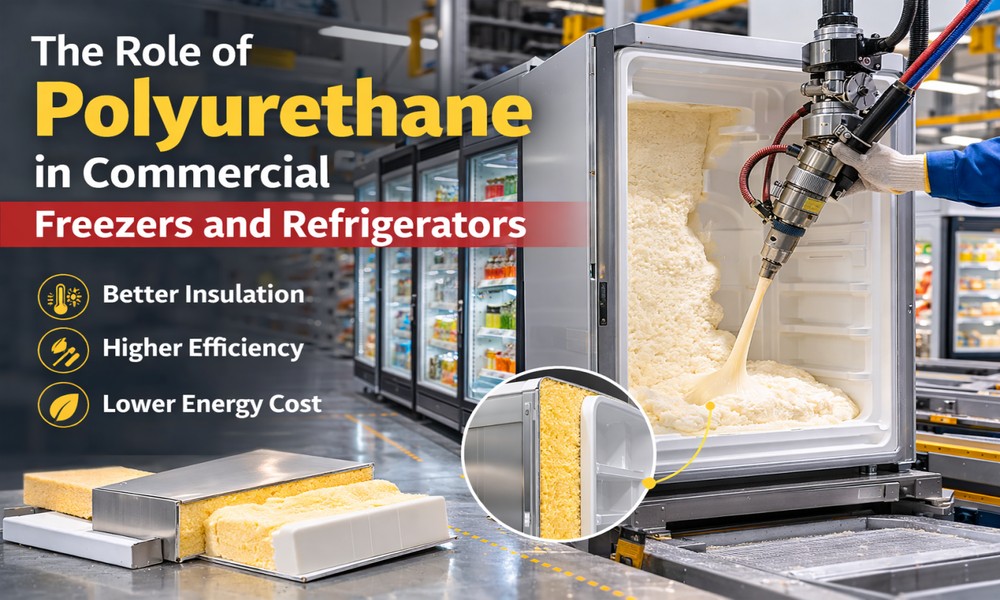
Most modern commercial refrigerators and freezers use rigid polyurethane foam as the primary insulation material. This foam is typically injected by PU foam machines between the outer metal shell and the inner plastic liner of the appliance, forming a highly effective thermal barrier.
The foam fills all cavities inside the appliance walls and doors, ensuring uniform insulation and eliminating air gaps that could reduce performance.
Advantages of rigid polyurethane foam
|
Property |
Benefit for Refrigeration Equipment |
|---|---|
|
Low thermal conductivity |
Maintains stable low temperatures |
|
Closed-cell structure |
Prevents air and moisture infiltration |
|
High structural strength |
Improves appliance durability |
|
Lightweight |
Reduces overall equipment weight |
|
Long service life |
Maintains insulation performance for years |
Because of these characteristics, polyurethane foam has become the standard insulation material used in nearly all refrigerators manufactured today.
Energy Efficiency Improvements
Energy efficiency is a major concern for commercial refrigeration systems because they often operate 24 hours a day. Polyurethane insulation significantly improves efficiency by reducing heat transfer between the interior of the refrigerator and the surrounding environment.
Studies show that modern insulation technologies, including polyurethane foam, have contributed to major reductions in refrigeration energy consumption over the past decades.
Better insulation means that compressors run less frequently and maintain stable temperatures more easily.
Energy savings benefits
- Lower electricity consumption
- Reduced compressor workload
- Improved temperature stability
- Longer equipment lifespan
- Reduced operating costs
Some advanced polyurethane insulation technologies also integrate vacuum insulation panels (VIPs), which further reduce heat transfer and increase energy efficiency in high-performance refrigerators.
Structural Strength and Appliance Design
In addition to insulation, polyurethane foam also contributes to the structural integrity of refrigeration equipment. When injected between metal panels, the foam bonds strongly to the surfaces and forms a rigid “sandwich structure.”
This design provides several engineering advantages.
|
Structural Feature |
Resulting Benefit |
|---|---|
|
Foam bonding to metal panels |
Increased structural rigidity |
|
Uniform foam expansion |
Elimination of internal gaps |
|
Lightweight core material |
Easier transportation and installation |
|
Improved vibration damping |
Reduced noise during operation |
Polyurethane foam also allows manufacturers to design thinner walls while maintaining insulation performance, which increases the internal storage capacity of refrigerators and freezers.
This is particularly important for commercial appliances where maximizing storage volume directly improves business efficiency.
Moisture Resistance and Temperature Stability
Refrigeration equipment often operates in humid environments, especially in supermarkets, food processing plants, and restaurant kitchens. Moisture infiltration can significantly reduce insulation effectiveness and cause frost buildup.
Polyurethane foam provides excellent resistance to moisture because of its high closed-cell content, which blocks water penetration and vapor transmission.
This moisture resistance helps maintain stable insulation performance even under challenging conditions.
Additional environmental advantages
- Reduced condensation formation
- Improved freezer temperature consistency
- Less frost buildup
- Increased equipment reliability
These properties are particularly valuable for walk-in freezers and cold storage rooms, where maintaining stable insulation over large surfaces is essential.
Polyurethane in Walk-In Freezers and Cold Rooms
Large commercial refrigeration facilities-such as supermarket cold rooms and industrial storage warehouses-often use polyurethane insulated sandwich panels for walls, ceilings, and doors.
These panels consist of:
- Metal outer sheets
- Polyurethane foam insulation core
- Protective coatings
The polyurethane core provides the thermal barrier that keeps cold air inside the storage environment.
Typical applications include:
- Food distribution warehouses
- Meat and seafood processing facilities
- Dairy storage rooms
- Pharmaceutical cold storage
- Logistics refrigeration centers
High-density polyurethane insulation panels can achieve excellent insulation performance while maintaining mechanical strength.
Polyurethane in the Global Cold Chain
Polyurethane insulation is not limited to refrigerators alone. It also plays a key role across the entire cold-chain system that delivers food from production to consumers.
Applications include:
- Refrigerated trucks and containers
- Cold storage warehouses
- Food transport boxes
- Industrial freezers
- Refrigerated vending machines
Polyurethane helps maintain low temperatures throughout the food supply chain, reducing food spoilage and preserving product quality.
In fact, experts estimate that effective refrigeration-enabled in part by polyurethane insulation-plays a major role in preventing food waste during storage and distribution.
Sustainability and Future Developments
As energy efficiency standards continue to tighten globally, the refrigeration industry is investing in improved insulation technologies. Polyurethane foam systems are evolving to meet these requirements through:
- Lower thermal conductivity formulations
- Environmentally friendly blowing agents
- Improved recyclability
- Compatibility with advanced insulation technologies
For example, modern polyurethane insulation systems can help manufacturers meet strict energy regulations while reducing environmental impact.
In addition, polyurethane’s ability to maintain insulation performance for decades makes it a sustainable choice for long-term appliance operation.
Polyurethane is one of the most important materials used in commercial refrigeration equipment today. Hidden inside the walls and doors of freezers and refrigerators, rigid polyurethane foam provides the insulation that keeps food cold, preserves energy efficiency, and ensures reliable operation.
Its low thermal conductivity, structural strength, moisture resistance, and lightweight properties make polyurethane the ideal insulation material for modern refrigeration systems.
From supermarket display freezers to large industrial cold storage facilities, polyurethane continues to support the global cold chain by helping maintain safe food temperatures and reducing energy consumption.
As refrigeration technology advances and energy efficiency becomes increasingly important, polyurethane will remain a key material in the design and performance of commercial freezers and refrigerators.
